Research to Practice: Building on Findings from our Nature-Based Approach
September 30, 2025By Kristin Licardi, LCSW, Green Chimneys Chief Clinical Officer
Decades of research tells us that healing happens in relationships, and that strong connections between humans, animals and nature lead to greater psychological and physical well-being. At Green Chimneys, the positive impact of human-animal and nature-based interactions was always felt, yet it was only anecdotal. For years we wondered whether we could capture real data that would allow us to determine if the animal-assisted and nature-based interventions did indeed positively affect clinical outcomes for our youth.
 In 2016, a research endeavor with University of Denver’s Institute for Human-Animal Connection was born from a shared goal in documenting and measuring the effects of nature-based interventions on youth outcomes. Various projects were designed to validate and optimize our programs, provide supporting evidence for our hypothesis, and translate research findings to clinical practice.
Looking at Youth Through a Strengths-Based Lens
Green Chimneys’ therapeutic environment and Guiding Principles naturally lent themselves to utilizing the Positive Youth Development (PYD) model as our theoretical framework. Green Chimneys prioritizes its practices around an individualized and strength-based approach built on positive reinforcement and collaboration. Developed by Richard Lerner and colleagues at Tufts University in the 1990s, the PYD model is a strength-based, practical assessment that says, when young people have the right relationships, opportunities, and supports, they don’t just avoid problems, they thrive. The “5 C’s” are the components of thriving and include Competence, Confidence, Connection, Caring, and Character.
Over the past nine years, we have amassed quite a bit of data, both qualitative and quantitative, including comprehensive documentation of the types of animal-assisted and nature-based interventions at Green Chimneys. Research to date includes crisis incident data analysis; qualitative studies developing an understanding of potential pathways of change; behavioral coding of video footage showing students before and after animal-assisted interventions; and validated self-report instruments administered with youth quarterly via the Positive Youth Development-Short Form (PYD-SF), and Social Emotional Assets and Resilience Scales (SEARS) assessment.
A few of the things we have learned so far:
- Animal-assisted interventions have a positive effect on emotional and behavioral regulation and time on task. In examining classroom video clips pre- and post-farm activities, and analyzing for self-regulation and on-task behaviors, we were able to detect significantly improved self-regulation, both in anticipation of, and directly following, farm activities as compared to control activities, with a 15% increase in on-task behaviors after engaging in human-animal interaction.
- The PYD-SF for assessing social and emotional competencies of youth is now validated for use with a clinically defined population. This first known application of the tool in a special education setting demonstrates that practitioners who work with youth facing mental health challenges may now reliably use it.
- Social emotional functioning constructs of caring, connection, and character have been shown to be particularly important in therapeutic work with Green Chimneys students. Student PYD survey scores related to these constructs can inform clinical practice and further attune programming to individuals’ unique needs, with the goal of increasing these attributes over time.
Read Findings Published To Date
Putting into Practice
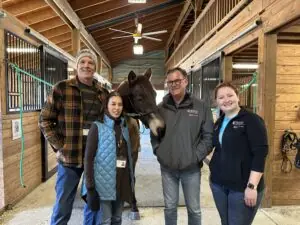
Green Chimneys Ross Institute leadership, Michael Kaufmann and Miyako Kinoshita, with key members of Denver research team, Kevin Morris and Marisa Motiff.
We have now expanded our focus to helping staff understand how to best utilize the interventions to optimize their impact, and use new clinical tools to assess and track student progress across Positive Youth Development and self-regulation measures. With this information, we can learn more effective ways to harness our animal-assisted and nature-based interventions, and train staff to fully integrate this approach in their work to build the strengths, skills, and supportive relationships that our youth need to thrive.
Green Chimneys is a complex and dynamic research environment, making it challenging to parse out the effects of human-animal and nature-based interaction vs. the Green Chimneys environment as a whole. It is likely that the entire experience is critical in driving positive outcomes for our youth. Our research partnership with Denver has been careful to preserve the integrity of the Green Chimneys program, while continuing to measure the effects and mechanisms of our animal-assisted and nature-based interventions.
This content appeared in Institute Insights, the official newsletter of The Sam and Myra Ross Institute at Green Chimneys. The Ross Institute serves as a model and training site for the varied facets of human-animal and nature-based interactions, grounded in evidence-based practices for implementing diverse and ethically responsible educational and therapeutic interventions and activities.
Join the discussion and subscribe to Institute Insights >