The Concept of ‘Home’ for Animals
September 22, 2026By Miyako Kinoshita, M.S. Ed., Green Chimneys Assistant Director of Nature-Based Education
Author’s note: At Green Chimneys’ 2026 Human-Interaction Conference, HERD Institute Founder Veronica Lac shared her experience of moving, and having to make the difficult decision to send her horses to the best home she could find, away from where she would be living. Several months later, I delivered the closing keynote at HERD Institute’s 10th Anniversary Conference to talk about Animal-Assisted Services and the meaning of “home” for the partner animals in our care. The presentation inspired additional thoughts about the experience of animals in a setting like Green Chimneys, and what comprises an animal’s concept of home. For the purpose of this article, ‘animals’ refers to domesticated companion animals we care for at Green Chimneys; mammals that live as herd, flock, or pack animals.
What Makes a Home?
By definition, “home” for humans, is a physical or psychological place of residence, comfort, and belonging. Home provides a center for our lives, including family members, and is a place of safety and acceptance. Home also references being part of a community, representing a sense of belonging, mutual support, and a network of relationships where people care for and interact with one another. When we talk about being “at home,” we often include the communities we surround ourselves with, and humans and animals in our network as a part of our daily existence.
When talking about the concept of home specifically for (farm) animals, dwellings are perceived as mere shelters in biological or functional categories (Burns et al. 1989, Bronner 1992, Hansell 1993, Kinlaw 1999). For animals, home is an anchor point tied to safety, routine, reliable food supply, and their herd or flock. (Efrat Blumenfeld Lieberthal, David Eilam, There Is No Place Like Home: Behavioral and Physical Home Traits in Humans and Other Animals, BioScience, Volume 76, Issue 3, March 2026, Pages 222–237)
Historically, and even today, animal care standards often define their “home” by food, shelter, and water. The Five Freedoms of Animal Welfare has been the gold standard for care, from house pets to service animals to educational partners and other working animals:
- Freedom from Hunger and Thirst
- Freedom from Discomfort
- Freedom from Pain, Injury, or Disease
- Freedom to Express Normal Behavior
- Freedom from Fear and Distress
There is a distinct line drawn between humans and animals. Humans have traditionally placed themselves above animal species, believing that a sense of belonging, community, or social relationships are human-specific traits that make us inherently dominant. Over the years, multiple studies in animal behavior have proved that theory wrong, and we now acknowledge that animals have feelings, relationships, and social structure. We understand the need to recognize that an animal in our care is much more than a creature that needs a dwelling and basic sustenance. The Five Freedoms defend against potential negative or adverse experiences for animals yet, eliminating such experiences is not enough if we also want to ensure that they have an enriched and meaningful life, and can call our shared community “home.”
The Interior Lives of Animals
In my nearly 30 years of working in the animal field, science has been uncovering the social and emotional life of animals and insects. They play, they mourn loss and death, and many herd and flock animals rely on each other to raise their young. They communicate and speak with each other in ways that we humans do not understand. However, once we stop expecting animals to think and behave like humans, and instead attempt to understand and speak their languages, we start seeing their own communities, families, and social structure. We also see that their quality of life is elevated once we are more aware that enjoyment, relaxation, and amusement are part of many domesticated animal’s lives.
The concept of home, for the animals in our care, is not far from our own. However, humans generally have the ability to make choices as to where and how they live. We cannot forget that there are people throughout the world who are born into difficult or unsafe circumstances, or who may not grow up in an ideal setting so ‘home’ can mean just shelter and basic needs, or not even that for some. Similarly, our animal partners do not have autonomy and choices in their lives and the place they call home, some are lucky enough to have care that goes beyond basic needs, but some are not.
In asking friends and colleagues to describe how they define home, some said physical location or local communities, some identified family members, and many described home in sensory terms: smell, sounds, and familiar visuals. Many of the things we associate with home seem to live inside us as a feeling vs. an exact physical location or landmark. While we are in these safe and comfortable environments called home, we are building a piece of it inside us. Every experience within the home with one another builds resilience. When there is a challenge we need to resolve or figure out, we learn from our community in a safe environment that allows mistakes and growing. When we feel uprooted either physically or emotionally, we pull these strengths from the home inside us.
We observe very similar things in animals; a dog’s favorite bed may have more to do with the familiar scent and the dent that is made just to fit its body, rather than its color, or shape. Animals at our farm feel safe in our familiar structure but they also prefer being with their companions and having days without strange sounds or objects in our environment. At times, they express who they choose to be their closest companions and some animals do not really get along, but they learn to live within the community, and make it safe. I believe resilience exists in our animals at the farm; when they change herd, when there is a loss, or if they go to another farm, they have built enough strength and confidence, and use it to adjust to a new situation.
Remembering Spadi the Horse
I often dream at night of my childhood home or friends, and I wonder if our animals do the same. These moments remind me that home is inside me, not an external structure or building that we live in. I have four very distinct places I identify as home: my native Japan; my home in Connecticut; the ocean; and the woods. These places appear in my dreams and make me happy. I always have the desire to be there and my heart aches when I think about some of them. Though I do not have physical access to them all the time, I can smell, feel, taste, and hear these places, which are filled with memories. This grounds me and helps me when I’m stressed.
I wonder if a horse may recall its first pasture when the breeze brings a familiar scent, or if a cow thinks of the faraway place he came from while sitting down and chewing on cud. Do they have memories of other places, smells, sounds, and things they touched? Do they have memories of other animals that they grew up with, or particular interactions or play?
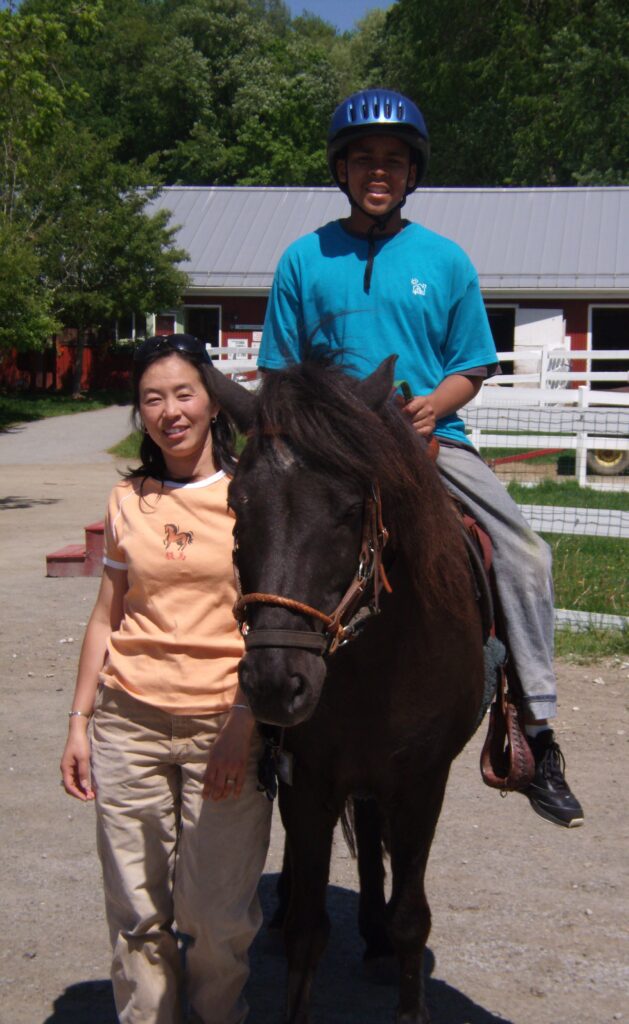
I think of an Icelandic horse named Spadi, who was brought to Green Chimneys from Iceland in 2000. He was from a herd of very special horses hand-selected to live and work with American children. We were fortunate to receive him and his companion, and Spadi spent 20 years in our barns, loved and cared for by staff and students.
His move from Iceland to the United States was not easy. He was allergic to biting insects and other environmental things here, and struggled to adjust. He transitioned from the vast fields and mountains, with a herd of hundreds of horses to small paddocks and just a few fellow horses. The companion he arrived with passed away from cancer in 2009 but Spadi continued to do well and in many ways, he thrived. He was very comfortable in his herd, enjoyed the human attention he received, and was clearly content. However, there was something a bit sad about him that I could never get over.
I traveled to Iceland in 2019, and visited a stable in the area where they raise these horses. The horses were on a volcanic mountain far away, with access to streams, grasslands, and ocean. I tried to imagine how hard it might have been for Spadi to leave that environment and go to a foreign country to live at a farm in the suburbs. That same year, Spadi was accepted to a beautiful retirement equine farm with 50 acres of pasture, in a setting similar to his original home and much larger herd. While I felt relief and happiness over his “happy ending,” I often still wonder how he processed all of these changes. I thought about the life we gave him at Green Chimneys, all the care and attention, and hoped it gave him strength to adjust and thrive the best he could.
Home, for humans and animals alike, needs to be a place where we can build memories. I believe many animals we have, herd and flock animals, do have the sense to call this place home. While they do not know what will come next, they have stability, tranquility, and joy while with us. Being able to provide such a home to animals is significant in our work with students. In modeling how to foster a supportive community, and asking students to be a part of that, we are showing them what it means to have home and connection, and the value and importance of a safe and secure place. Home truly is where the heart is, and we all find a piece of home at Green Chimneys.
This content appeared in Institute Insights, the official newsletter of The Sam and Myra Ross Institute at Green Chimneys. The Ross Institute serves as a model and training site for the varied facets of human-animal and nature-based interactions, grounded in evidence-based practices for implementing diverse and ethically responsible educational and therapeutic interventions and activities.
Join the discussion and subscribe to Institute Insights >