Intern Perspectives
For many Leir Interns, time at Green Chimneys becomes the basis for lifelong work in animal-assisted services. For others, it provides a solid foundation for other career paths.
Former interns reflect on how the program shaped their professional life, expanded their understanding of the human-animal relationship, and reinforced the importance of animal welfare and agency. Their experiences show how immersive learning and meaningful connections with people and animals continue to influence a career long after an internship ends.
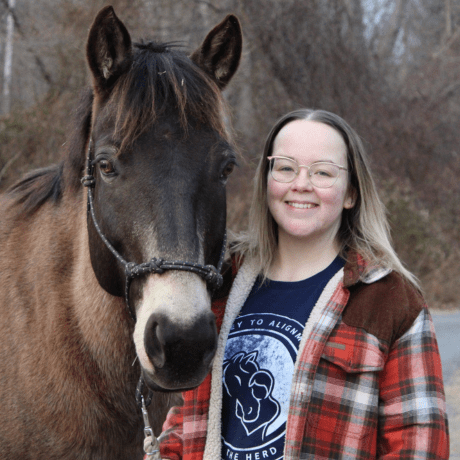
Becky Cobban, MSW
Equine-Assisted Learning Practitioner, Edinburgh Equilearn
Leir Intern 2019-2021
Becky Cobban holds a Master’s degree in Social Work from the University of Edinburgh and is a PATH International–certified Therapeutic Riding Instructor. Her professional journey began as an intern at Green Chimneys, where she later returned as an Equine Program Facilitator, deepening her experience in equine-assisted work. Based back in Scotland, Becky works as an Equine-Assisted Learning Practitioner with Edinburgh Equilearn, a small community interest company. She is passionate about honoring animal choice and autonomy within equine sessions, and believes that learning through a horse’s responses and decisions offers powerful opportunities for individuals to gain insight, self-awareness, and personal growth.
When was your internship at Green Chimneys?
I was a farm intern from 2019 until 2021 in the Horse Barn. I initially plan to intern for one year but extended to two as I completed my PATH Intl. Therapeutic Riding Instructor certification.
How has the Green Chimneys farm internship influenced your career in animal-assisted services?
After graduating with a degree in Psychology, I was unsure where my career would lead me but after combining my loves for animals and helping people during my internship with Green Chimneys, I knew it was the career for me. Since my internship, I have completed my Master’s in Social Work in order to further my career in Animal-Assisted Services. This led to my return to Green Chimneys as a staff member; I spent 18 months as the Equine Program Facilitator and was able to put my Social Work degree into practice alongside the clinical teams at Green Chimneys. I am currently the 1-1 Wellbeing Facilitator at a small CIC called Edinburgh Equilearn, where I provide equine-assisted services to children in the Edinburgh area. I not only learnt about the field from my internship but also made worldwide connections.
What was the most unexpected thing you learned during your internship?
Despite working in the Horse Barn, I was exposed to work with many different species of animals. I specifically remember being pleasantly surprised by how therapeutic sheep can be, as well as snakes, rats, ferrets, cockroaches, to name just a few! I also had the honor of working with camels during my internship and learnt about their care and communication.
Aside from the animal care and interaction, I learnt a lot about myself in terms of fostering community, learning about different cultures, as well as my own ability and confidence to move across the world and face any and every challenge. I will forever be grateful for Green Chimneys for transforming my confidence into who I am today and the friends I have made as a result.
Based on your experience, what should a prospective intern expect?
A farm intern should expect to learn about the in-depth systems that are involved in such a large-scale organization. I remember being amazed at how many different departments, not only at the farm, that you can be involved in. I personally got myself involved across the campus, through interactions with the dorms, the music department, the recreation program, and social services. This opened up my eyes to how many routes you can take within a career in Animal-Assisted Services, as well as careers that can run adjacent. I also learnt a lot about conflict resolution and communication. As with any position or job you may take on, there are struggles and through the incredible supervision and support I received as an intern, I was able to navigate through conflict and communication issues with the students I worked with, as well as colleagues and with animals, too.
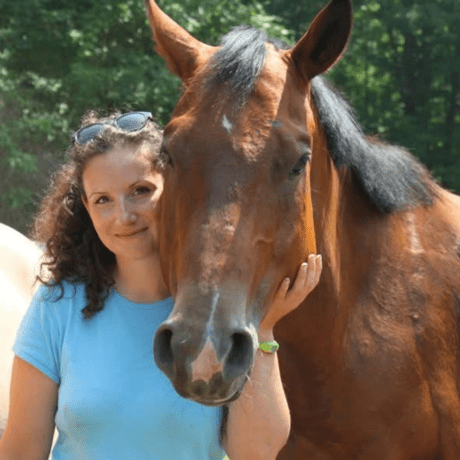
Dimitra Drago
Animal-Assisted Services Practioner & Educator
Leir Intern 2011
Dimitra Drago has always been passionate about nature and animals, and has gained extensive experience in animal-assisted services. As a certified therapeutic riding instructor and animal handler, she works with dogs, horses, donkeys, and farm animals and is involved in a wide range of nature-based therapeutic and educational programs, including visitation at nursing homes, residential facilities for people with disabilities, and hospitals; teaching farm programs; summer camps at the farm; educational programs about animals in schools and at the farm; and animal-assisted interventions for children with special needs. Her work also focuses closely on the value of the animal’s active involvement in sessions, while respecting and safeguarding the animal’s agency and choice, as well as ensuring its welfare.
Dimitra holds a degree in Developmental and Educational Psychology from University of Milano-Bicocca, and Master’s degrees in Animal-Assisted Activities, Animal-Assisted Education, and Animal-Assisted Therapy from Catholic University of the Sacred Heart of Milan, and in Emotional Education, Social and Emotional Learning, and Well-being at RIEEB Barcelona (International Network for Emotional Education and Well-being). She also teaches in animal-assisted services certification programs for mental health professionals and animal handlers, and serves as a Regional Representative of the International Association of Human–Animal Interaction Organizations (IAHAIO).
When was your internship at Green Chimneys?
I started as an intern in 2011. I initially planned to stay for just a few months but I really enjoyed the environment and I was excited about everything I was learning. So I extended my internship and ended up staying for a full year.
How has the Green Chimneys farm internship influenced your career in animal-assisted services?
The Green Chimneys Farm Internship had a significant influence on my professional path and on the way I think about animal-assisted services. This experience was truly life-changing for me. It gave me the opportunity to experience firsthand how animals can be involved in therapeutic and educational settings while being respected as active participants rather than simply as tools or resources. Before the internship, I already believed in the importance of the human-animal relationship, but being at Green Chimneys allowed me to experience it in everyday life and to understand its meaning on a much deeper level.
One of the most important things I took away from the experience was the idea that animals should not simply be considered tools to achieve a therapeutic or educational goal. They are individuals and active participants in the relationship, with their own personalities, preferences, needs, and boundaries. This experience made me much more aware of the importance of respecting their agency and ensuring that their welfare is always taken into consideration. The experience also taught me to be more patient and observant. Sometimes, instead of trying to make something happen, it is more meaningful to step back, observe, and allow the animal to decide whether and how to engage. This is something I carry with me in my professional practice.
What was the most unexpected thing you learned during your internship?
The most unexpected thing I learned was how much animals can teach us when we slow down and really pay attention to them. I learned that sometimes the most meaningful interactions are not the ones we plan, but the ones that happen naturally when we allow the animal to make choices; animals themselves can have an active role in shaping an intervention. This taught me the importance of flexibility, observation, and being able to adapt to the animal and the person in front of me.
I became much more attentive to body language and to the small signals animals use to communicate whether they are comfortable, interested, uncertain, or simply need some space. I also learned that respecting an animal’s decision not to participate can be just as important as encouraging its participation. This changed my understanding of what a successful animal-assisted intervention can look like. I realized that a successful interaction is not only about what the person gains from it, but also about making sure that the experience is appropriate and positive for the animal.
Based on your experience, what should a prospective intern expect?
Expect to be involved in many different aspects of farm life and to learn through direct experience. You’ll be welcomed by a team of professionals who share their knowledge, and make everyone feel included. It’s a very hands-on and immersive experience – it’s not only about working with animals during activities, it’s learning how to care for them, observing their behavior, understanding their individual needs and boundaries, and becoming familiar with their daily routines.
Interns should also expect to be challenged both personally and professionally. Every day can be different, and working in a farm environment requires flexibility, responsibility, teamwork, patience and the ability to adapt to situations that do not always go according to plan. Every animal is different, and what works with one may not work with another. Most importantly, interns should be open to learning from both the people and the animals, and understand that the animals’ welfare must always be a priority. The experience can really change the way you look at animal-assisted services and at the role animals can play in our lives
Most of all, I would say: be curious, be patient, and listen to the animals. The more you learn to observe them without trying to control the interaction, the more you can appreciate their individual personalities and the role they can have in animal-assisted services.
What did you appreciate most during your internship?
My time as a farm intern was a very meaningful experience, both personally and professionally. Living and working in an environment where animals, people, education, and therapy were closely connected allowed me to gain a deeper understanding of what animal-assisted services can be.
What I appreciated most was seeing how important it is to build relationships with animals based on trust, respect, and mutual understanding. I learned that involving an animal in an intervention also means taking responsibility for that animal and making sure that its needs and well-being are respected. What stayed with me was the feeling of being part of a community where animals were not simply “used” for therapeutic or educational purposes, but were valued as individuals. Seeing this approach in practice helped me understand that animal-assisted services should be beneficial for both sides of the relationship.
Animals are not there simply to benefit people. Their participation should be meaningful and voluntary, and their welfare should always be a fundamental part of the intervention. This is probably one of the most valuable lessons I took home with me from Green Chimneys.
What did you take with you after the internship?
Looking back, I feel that Green Chimneys gave me much more than practical experience. It changed the way I look at animals and at my responsibility toward them. I came away with a stronger belief that animals should have a voice in the interactions they take part in, and that their welfare, choice, and agency should always be at the heart of animal-assisted services. Connection cannot always be planned or measured, and that sometimes giving an animal the freedom to choose is the most meaningful thing we can do. It was an experience that challenged me, taught me, and ultimately helped me better understand the kind of professional I wanted to become.
My time at Green Chimneys is something I will always remember, not only because of what I learned professionally, but also because of the relationships I built with the animals and the people I met there. I feel deeply connected to this place and to the people I met there because they opened my eyes to a whole new world: the field of animal-assisted interventions. They guided and supported me throughout my professional growth. Every time I return to Green Chimneys, I feel like I’m coming home.