Announcements

By Michael Kaufmann, Green Chimneys Vice President of Nature-Based Programs & Director of The Ross Institute
As a community focused on health and well being, guided by the One Health-One Welfare philosophy, Green Chimneys places strong emphasis on the care of the animals working in our animal-assisted services. Recognized as valued partners in the interactions with students and staff, our animals’ physical, social, and behavioral health is always of utmost importance, and considered critical to conducting purposeful activities.
Throughout our programming, animal care and protocols align with the standards established by the International Association of Human-Animal Interaction Organizations (IAHAIO). From selection and training to care and continuous evaluation, every stage of an animal’s involvement is shaped by our commitment to animal welfare. While the primary objective of our program remains focused on the human benefits, it is essential that the animals are active, willing participants in every interaction and increasingly, also given the choice to opt out of participation.
At the recent IAHAIO conference in Amsterdam, professionals including veterinarians, researchers, trainers and human service providers discussed the challenges of defining animal agency, and how one can programmatically practice this concept of giving animals choices in day-to-day activities. Animals cannot give consent in the same way that humans do; it is a fact that humans control the lives of domestic animals. Animals are the legal property of an owner/caretaker and keeping them safe, containing them, or making major life and death choices for them require human decisions and action. This reality injected differing opinions into discussions around the extent of animal agency and precise application in working with dogs, horses, goats, and guinea pigs in human service settings. What united the group was a sincere commitment to place even greater attention to how animals engage with people, and to explore and critically evaluate practices.
In recent decades, work with dogs has seen a shift from control and dominance training to a more cooperative and interactive style of communication. Humans must retain a healthy, calm leadership role and guide their dog to ensure safety and harmony. There are many ways that training and daily activities can give a pet or service partner more opportunities to make decisions and choices. In 2024, the American Kennel Club published an article focusing on how to Empower Your Dog by Offering Them More Choices and Autonomy. Animal-Assisted Services programs working primarily with canines have adopted this more collaborative approach. For example, if a visitation dog is indicating that it wants to leave a patient room at a nursing home, the handler must respect that choice and allow the dog to do so. Service providers are becoming more educated in recognizing subtle stress signals in their dogs, and how to then adapt.
The concept of cooperative care is effective among non-domesticated animals, as well. Leading zoos and facilities working with exotic species have embraced the approach so that lions, gazelles, elephants, and even crocodiles, can be conditioned to willingly participate and accept vaccinations, foot care or other procedures. What is Cooperative Care?
The justification for working with animals in a different way comes via a growing base of scientific evidence that validates cooperative care and the importance that choice plays in ensuring animal wellbeing. In their paper Choice, control, and animal welfare: definitions and essential inquiries to advance animal welfare science (Englund, Cronin 2023), the researchers concluded that “providing choices to captive animals will continue to prove an excellent strategy to improve their welfare while also enabling us to learn about their preferences, choice behavior, and cognition more generally.” The influence of human interaction on guinea pigs (Wirth, et al) focuses on how guinea pigs prefer human interaction when given some choice in the process, and when offered the ability to retreat. Other published studies echo these findings and there is a growing understanding of the value in offering animals options in order to improve their quality of life.
Not surprisingly, animal-assisted service providers all over the world are currently developing and implementing new approaches with diverse species. These advancements often come in small steps, as practitioners refine their work and rethink standard procedures. At Green Chimneys, we work with over 250 animals of many species as part of our program for children with special needs, and animal care staff have tackled the task with enthusiasm.
Across the equine barn, farm animal areas and wildlife center, staff are even more attentive to subtle signs of stress in goats, pigs, cows, ferrets and other species before, during and after interactions. Behaviors such as panting, avoidance, ears pinned back, feather ruffling, yawning and freezing can signal that the animal may be asking for an adaptation in the activity. These cues deserve consideration and a course correction as soon as they are recognized. Our goal is to be more attuned to each individual animal partner, integrate options into their everyday activities, and design human-animal interactions that are genuinely mutually beneficial.
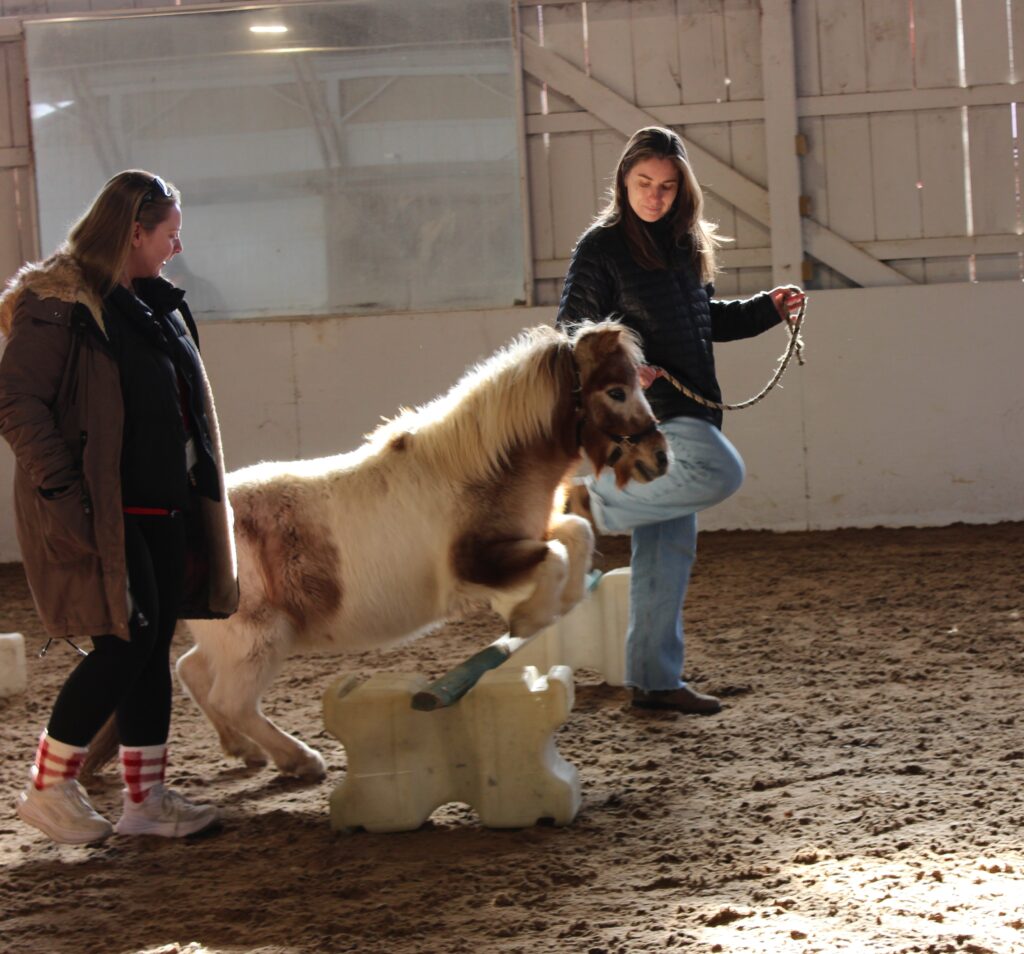
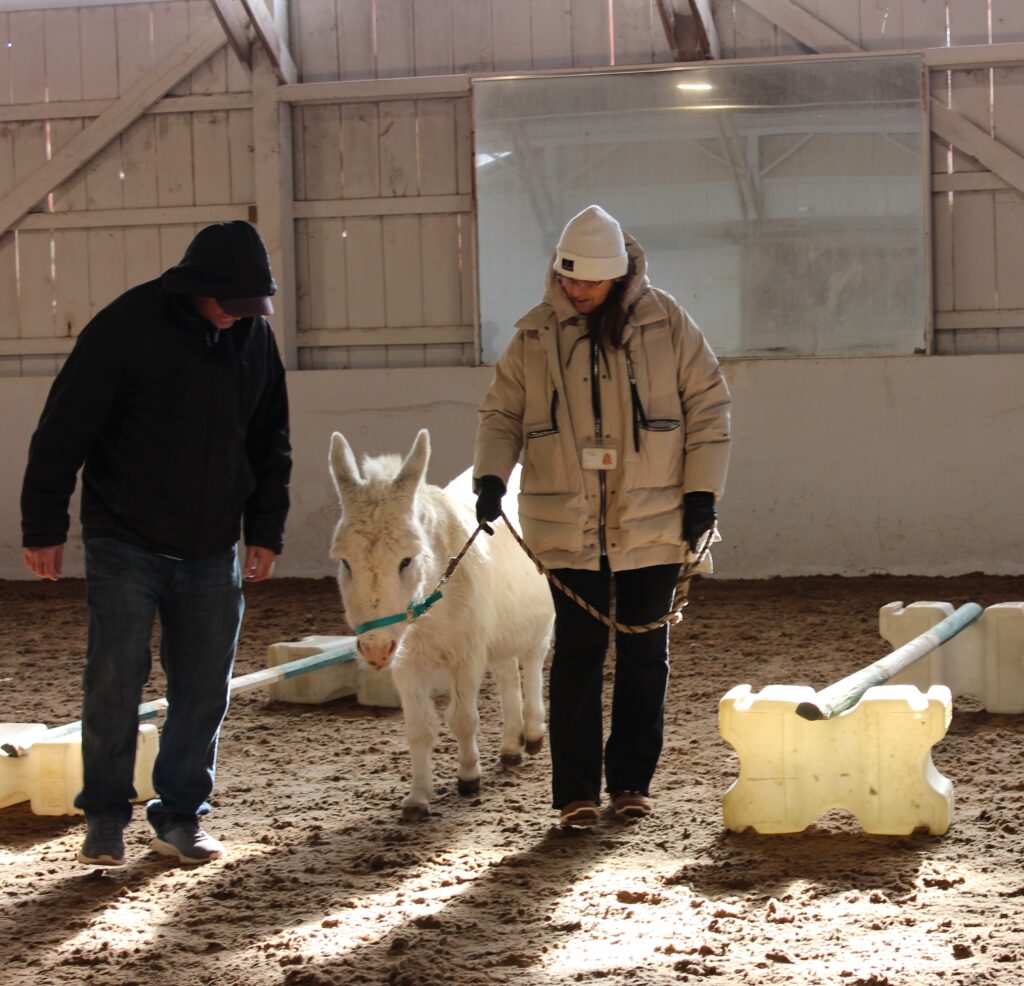
Above: Green Chimneys social workers practice partnering with equines for animal-assisted session work with students. In one exercise, the group leads mini horses through an obstacle course, allowing the animals choice in how they approach or complete each individual element. The goal of the activity is to explore differences in abilities, personalities and interests, along with strategies for communicating effectively with animal partners. Social workers observe and honor the ways in which the animals engage with the obstacles, facilitating opportunities for their partner animals to reattempt obstacles perceived to be accessible through encouragement. At left, Ari embraces and progresses through each element while Russell, at right, displays hesitation and circumvents several course features.
In the past, a guinea pig would have been lifted out of its cage and placed in a student’s lap during farm class. Now in the farm classroom, guinea pigs cross a ramp from their habitat directly onto the table where students can observe and engage with them, and return to their tank when they choose. If the classroom rats don’t come to their cage door at interaction time, the lesson continues without their participation. Since increasing our focus on giving our animals a choice, we have noticed a significant decline in nervous behaviors and an increase in sociability with people.
In the equine program, grooming horses with students was traditionally a one-way conversation, as a care task done “to” the horse. In order to have the horse be a more active participant, the team experimented with “Dialogue Grooming.” Here, the student selects two grooming tools at random and presents them to the horse; the horse responds by nuzzling or nudging its preferred tool. The student honors the horse’s choice and proceeds to use the specified grooming tool. Students are reminded to observe the horse’s reactions during grooming to gauge satisfaction, such as the horse leaning into the pressure, tilting their head, lifting their lips, or even falling asleep!
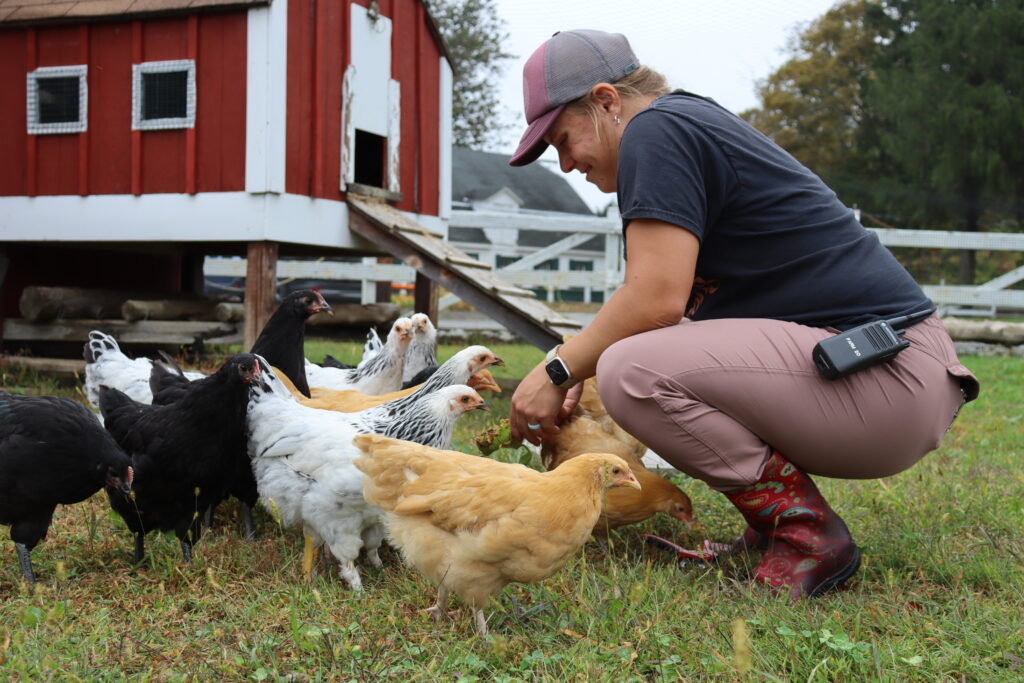
Even in the chicken coop, a new choice-based approach has enabled another type of interaction for both students and birds. The chickens are very popular and get a steady stream of visitors throughout the day, which can mean numerous hands seeking to pet or pick them up. Finding a way for students to interact without holding the birds was an important adaptation that brought about “Flock Walks.”
Farm staff conditioned the chickens to respond to the ding of a bell, signifying it’s time to leave the coop for treats and a walk. Several times a week, the chickens have the option to walk around the farm following a caretaker. They explore pecking here and there for worms under the watchful eye of humans. Each time the bell dings the flock regroups and resumes the walk until it is time to go back into the coop! There is no force, no chasing and no pressure, and the chickens follow willingly. Any hen not in the mood to join simply stays behind in the coop.
It is important to recognize how internal and external conditions can affect how an animal feels about participating in any activity. Observing the choices and reactions of animals gives the animal care team greater insight into individual personalities, creating a respectful working relationship and subsequently, more beneficial interactions.
We will continue to observe and reframe our understanding of how animals interact with us, what their preferences are, and how we can better communicate with them in the course of our educational and therapeutic work. The field of animal-assisted services, driven by its dedication to animal welfare, will continue to evolve and refine best practices. The Ross Institute at Green Chimneys is an eager participant in this journey and is committed to ensuring that animals can thrive in a human service program, and further enhancement of the positive impact and benefit to the human participants.
References
Englund, M. D., & Cronin, K. A. (2023). “Choice, control, and animal welfare: Definitions and essential inquiries to advance animal welfare science.” Frontiers in Veterinary Science
S. Dixon, CDBC, L. Fraser, CHBC, S. Edlund, CPBC “What is Cooperative Care?” IAABC Foundation Journal 2025
Wirth, S., Gebhardt-Henrich, S., Riemer, S., Hattendorf, J., Zinsstag, J., & Hediger, K. (2020). “The influence of human interaction on Guinea pigs: Behavioral and thermographic changes during animal-assisted therapy.” Physiology & Behavior
This content appeared in Institute Insights, the official newsletter of The Sam and Myra Ross Institute at Green Chimneys. The Ross Institute serves as a model and training site for the varied facets of human-animal and nature-based interactions, grounded in evidence-based practices for implementing diverse and ethically responsible educational and therapeutic interventions and activities.
Join the discussion and subscribe to Institute Insights >